1. Executive Summary
The story we expected to write this month was about firming. It isn't. May is the month Spanish origin rolled over.
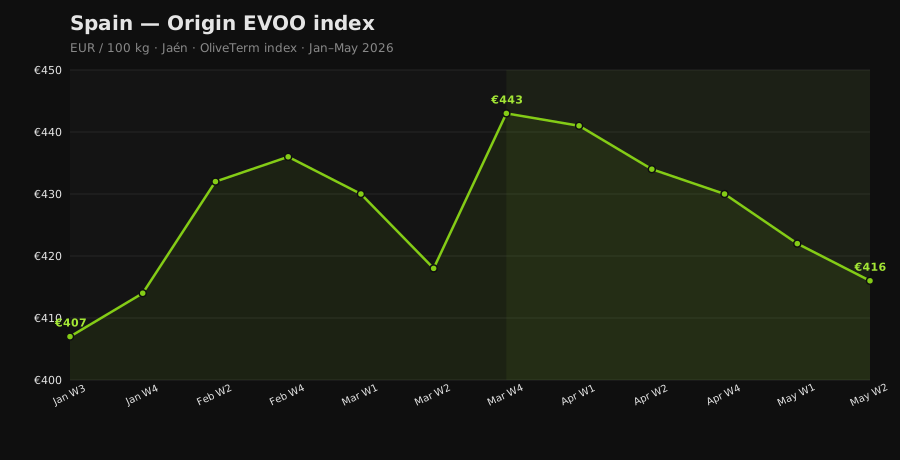
The top was late March — EUR 443/100 kg in the March 26 window. April was a holding month, origin oscillating in the 430s-440s and closing around EUR 442. Then the first days of May broke the range: our index was at EUR 416 by May 10, a clean step below everything April had printed, and the Poolred sessions since have come in lower still. This is not a one-print wobble; turnover was healthy on the way down, which means it's genuine selling, not a thin-market air pocket.
What's striking is why it's falling, because the obvious catalyst points the other way. The July 24 Section 122 expiry should be pulling US demand forward — buyers front-loading ahead of a possible tariff-free window — and that backloading is real. But it's being outweighed by two quieter forces: a 2026/27 flowering read that, heat pockets aside, looks broadly favourable across the western Mediterranean, and simple post-peak profit-taking after the run into late March. When the bullish story is the loud one and prices still fall, that tells you something about positioning.
Italy is the exception, easing only gently: Bari around EUR 620/100 kg, still carrying a large premium on its short crop. Greece is tracking Spain down to the EUR 415-420 area. Portugal sits just below Spain. And Tunisia is the quiet tell of the month — holding and even firming toward EUR 3.75-3.85/kg while Spain falls, quietly compressing the gap that has defined the trade all year.
2. Origin Prices by Country
Spain (Jaén)
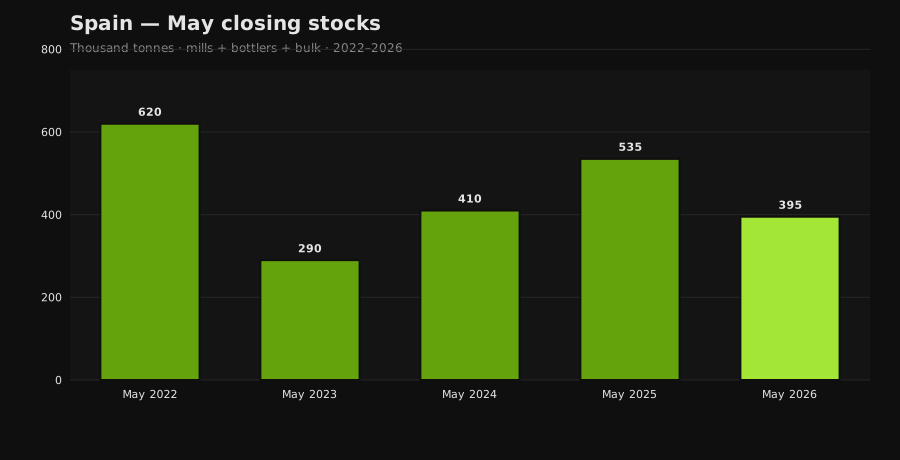
Jaén opened May in the low 420s and was at EUR 416/100 kg by the May 10 cutoff — down from the EUR 443 March peak and below the whole April range. Poolred turnover stayed healthy through the decline, so the market is clearing at lower levels rather than gapping on no volume. Combined mill, bottler and bulk stocks sit around 395 kt, still well below the same point last year — but in a falling market that tightness is buying sellers nothing. Retail bulk: EUR 4.20-4.45/kg conventional, EUR 4.90-5.15/kg organic, with more downside to come as origin feeds through.
Italy (Bari)
Bari eased to about EUR 620/100 kg, continuing the slow bleed from the winter highs as the production rebound feeds through — still 30%+ below a year ago. The Italy-Spain spread stays wide near EUR 200 because Italy's own crop was short; Italian bottlers keep importing Spanish, Greek and Tunisian oil to cover their blends.
Greece (Chania)
Chania tracked Spain lower to EUR 415-420/100 kg. Cooperatives that were holding out for higher prices are now watching the same rollover Spain is living, and some are starting to let inventory go. Closing stocks remain genuinely tight into Q4, which is the one structural support under Greek origin whatever the spot does.
Portugal
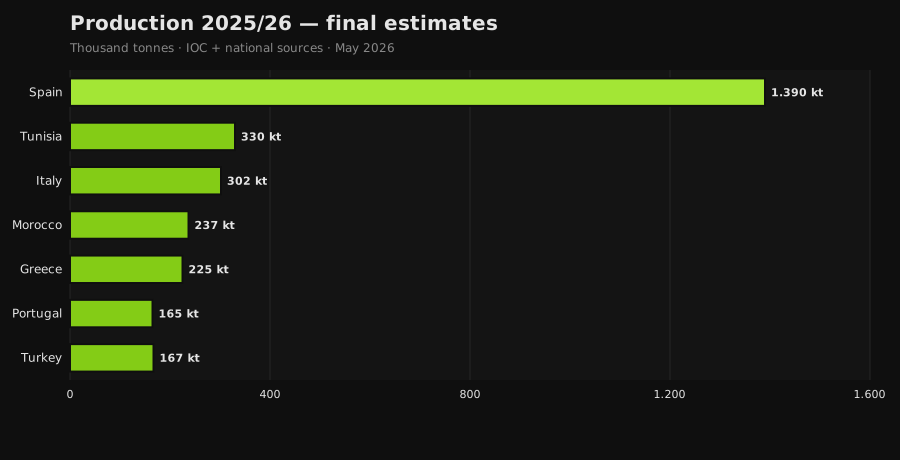
Portugal in EUR 405-415/100 kg, a small discount to Spain. Casa do Azeite has the 2025/26 national final around 165 kt — a normal-to-strong number, fully absorbed by the market.
Tunisia & Turkey
Tunisia is the month's quiet story. At EUR 3.75-3.85/kg conventional it is firming while Europe falls — strong export commitments to Spain, Italy and the US, and the first sustained bid since the 2025 correction. The gap to Spain, near EUR 100/100 kg in April, is compressing fast; the discount programme that has defined 2026 is starting to close. Turkey: domestic firmness, export licensing under selective restriction.
Global Benchmark (USA)
IMF/FRED for April: USD 5,950/t. With the euro-denominated slide passing through, partial-May data points lower, toward USD 5,600-5,700/t.
3. Consumer Price Dynamics
The European retail correction is plateauing. Eurostat's April HICP reading was -0.8% MoM, the smallest monthly move in over a year. From the 2024 peak: Spain -32%, Greece -28%, Portugal -24%, Italy -13% at the EU-4 level. The May origin drop won't reach shelves before late Q3 — retail lags origin by three to five months — but when it lands it should give the correction a second leg.
Import markets are still in their long tail: Germany -15% YoY through April, France -10%, the pace slowing. UK retail has stabilised as the bulk-price tailwind fades.
Volume recovery is the headline. Spanish retail volumes are +21% YoY in April, about 60% of the 2024 volume loss recovered. The remaining gap sits in the lowest income quartiles, where the substitution to seed oils has proven sticky.
4. 2026/27 Campaign — Flowering & Field Conditions
4.1. Andalusia
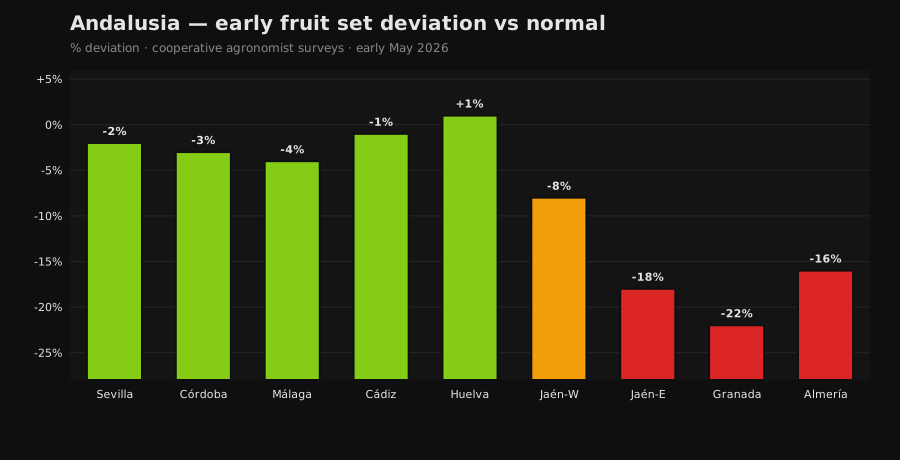
Flowering across Andalusia opened on the normal calendar but hit two heat events — April 26-29 (33-36°C) and May 4-6 (32-35°C). Cooperative agronomists in Jaén, Granada and Almería put fruit set in the affected sub-regions 12-22% below normal. Sevilla, Córdoba and Málaga — where the events were milder and the terrain softened them — look broadly normal. The Junta de Andalucía's first formal survey publishes June 5, and it is the single most important data point of the next sixty days. The market, for now, is treating the western-region normality as the headline and the eastern heat as a footnote — which is precisely why prices are falling.
4.2. Castilla-La Mancha & Extremadura
Both favourable. Spring rainfall adequate, soil moisture above norms, no major heat events. Early read points to a fruit set at or modestly above the five-year average.
4.3. Italy & Greece
Italy across Apulia, Calabria and Sicily remains favourable. Greece is just opening its window — Crete and the Peloponnese broadly normal, with adequate if not abundant soil moisture. Eastern Crete stays the one persistent flag, rainfall below trend.
4.4. Tunisia & Morocco
Tunisia flowers later and is just starting; soil moisture is below the long-term average across the centre and south after a dry winter, already showing in forward offers. Morocco favourable.
5. Trade & US Tariff Developments
5.1. Section 122 Countdown
July 24 expiry, about ten weeks out, no public signal of extension. The market is pricing a possible tariff-free window from late July into Q3. US importers have shifted accordingly — several large buyers delayed Q2 contracted volumes and re-tabled them for July-August arrival. That backloading is real; it just hasn't been enough to hold origin up against the supply-side read.
5.2. Section 301 / 232 Watch
Press reports cite officials deliberating a possible Section 232 edible-oils investigation. No formal initiation yet. Section 232 needs a Commerce finding and can produce tariffs in 4-9 months from initiation; Section 301 doesn't appear to be the favoured vehicle.
5.3. CIT Refund Status
CIT has ordered roughly USD 71 billion in refunds across all sectors. Olive oil specifically: processing roughly 60% complete, the rest expected by end-Q3.
5.4. EU Trade File
EU-Mercosur is in second-stage ratification, European Council vote scheduled May 21 — the olive oil schedule phases in over five years, first cut on entry into force. EU-India stays working-level.
6. 2026 Outlook & Updated Price Scenarios
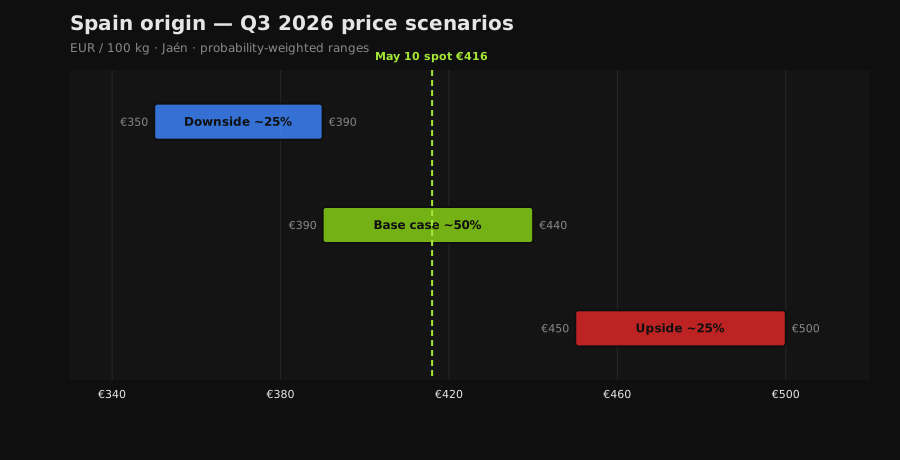
6.1. Base Case (probability ~50%)
The drift continues at a gentler pace: Jaén trades EUR 390-440/100 kg through Q3. The June 5 survey confirms a below-normal but tolerable eastern-Andalusia read, the recovery-crop narrative holds, and the tariff-window demand pulse cushions rather than reverses the move.
6.2. Downside (probability ~25%)
The June 5 survey comes in stronger than feared, Italy and Greece stay favourable, and the Section 122 pulse proves modest. The market re-prices toward the pre-2024-cycle EUR 350-390/100 kg range by late Q3. This is the scenario the price action is currently pointing at.
6.3. Upside (probability ~25%)
June 5 confirms material heat damage in eastern Jaén, Granada and Almería, and a sharp US backloading into the tariff window tightens available supply. Jaén rebounds to EUR 450-500. The weather tail is real, even if the market isn't paying for it today.
7. Strategic Recommendations
Buyers: the correction is working for you — stagger into it. With origin drifting from the low 420s and no confirmed floor, laddered purchases through June beat trying to time a bottom. Keep powder dry for the June 5 survey.
Sellers: don't chase the market down. Healthy turnover means you can be patient. If storage allows, the June 5 survey is close enough to wait for rather than dumping into weakness.
Hold directional positioning until June 5. That survey is the pivot. No large fixed-price commitments — for either side — before it lands.
Watch the Tunisia compression. A firming Tunisian floor against a falling Spain is the early signal that the discount trade of 2026 is closing. Programmes built on that spread need a rethink.
Quality is still the margin. In a softening bulk market, certified, branded, traceable oils are the only ones holding sustainable margin.
Disclaimer: This report is prepared using publicly available data from the International Olive Council (IOC), European Commission, FRED/IMF, Poolred, Eurostat, Casa do Azeite, ASOLIVA, Olive Oil Times, and other sector sources through May 10, 2026, together with OliveTerm's own price indices. Provisional figures may be subject to revision. This document does not constitute financial, commercial, or legal advice.